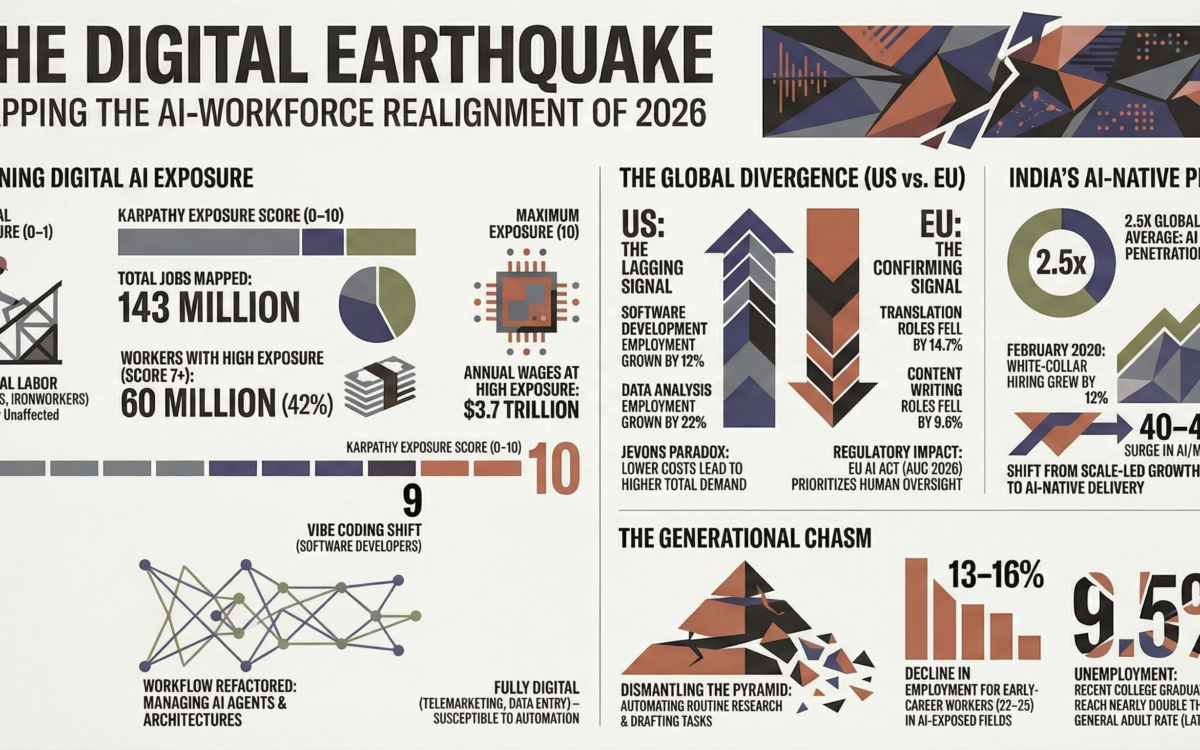
As of March 2026, the conversation around artificial intelligence has moved past theoretical debate and into a period of profound structural realignment. At the center of this transition is the US Job Market Visualizer, an analytical tool developed by Andrej Karpathy that maps 342 occupations—representing roughly 143 million jobs—against their susceptibility to “Digital AI Exposure”.
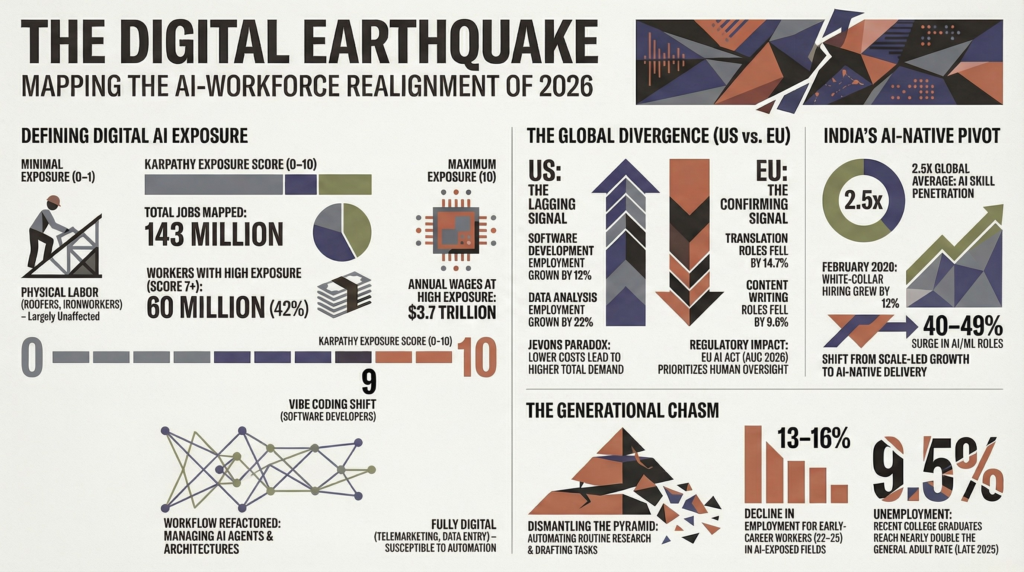
By utilizing large language models to score the Bureau of Labor Statistics (BLS) data, this framework provides a high-resolution map of the workforce. Approximately 42% of the US workforce—nearly 60 million workers—now holds an exposure score of 7 or higher, representing $3.7 trillion in annual wages. But as we look across the globe, the impact of this “digital earthquake” is manifesting in vastly different ways.
1. Decoding Your “AI Exposure”
The Karpathy framework assigns every occupation a score from 0 to 10 based on how much AI will reshape the role through automation or productivity gains.
- Minimal Exposure (0–1): Physical labor in unpredictable environments, such as roofers or ironworkers.
- High Exposure (8–9): Knowledge-intensive roles performed primarily on computers, such as software developers and data analysts.
- Maximum Exposure (10): Routine, fully digital information processing like telemarketing or data entry.
The critical takeaway from 2026 is that a high score does not necessarily mean job elimination. For instance, software developers score a 9/10 because AI has “refactored” their workflow into what is now called “vibe coding”—a state where developers manage AI agents and system architectures rather than just writing syntax.
2. The Global Split: “Lagging” vs. “Confirming” Signals
The 2026 data highlights a fascinating divergence between the US and the European Union. Researchers now categorize job trends into two primary signals: Lagging and Confirming.
In the United States, we see a “Lagging” signal. Despite high AI exposure, employment in sectors like software development has grown by 12%, and data analysis by 22%. This is often attributed to the Jevons Paradox: as AI makes the “production” of a digital task cheaper, the total demand for that output increases, keeping headcounts stable for now.
In the European Union, the signal is “Confirming.” High AI exposure is already translating into visible declines. Over the last three years, employment for translators and interpreters in the EU fell by 14.7%, while content writers saw a 9.6% drop. This shift is further solidified by the EU AI Act, which becomes fully applicable for most operators on August 2, 2026, prioritizing human oversight and transparency over rapid, unregulated automation.
3. India’s Strategic Reinvention
While the West navigates regulation and market friction, India has emerged as a “Global AI Talent Capital”. In 2025, India ranked 3rd in the Global AI Vibrancy Ranking, with a workforce possessing an AI skill penetration 2.5 times the global average .
The Indian tech sector is shifting decisively from “scale-led growth” to “AI-native delivery”. In February 2026 alone, white-collar hiring in India grew by 12%, driven by a massive 40% to 49% surge in AI and Machine Learning roles . Rather than seeing AI as a threat, Indian tech leaders are moving toward outcome-based revenue models, where AI-driven productivity is treated as a competitive advantage.
4. The Generational Chasm: The “Vanishing First Job”
The most concerning trend of 2026 is the erosion of entry-level work. AI is effectively “dismantling the pyramid” of professional apprenticeships by automating the routine research, drafting, and data tasks usually handled by junior staff .
Recent studies show that early-career workers (ages 22–25) in AI-exposed fields have seen a 13-16% relative decline in employment . While senior professionals can leverage AI to expand their “span of control,” the pipeline for new talent is constricting . The unemployment rate for recent college graduates in the US reached 9.5% by late 2025, nearly double the general adult rate .
The 2026 Verdict
The global impact of AI is fundamentally uneven. As the cost of running frontier models continues to decline—with local models in India now costing as little as $0.67 per hour—the barrier to entry for AI-led solutions has disappeared.
The future of work is no longer about competing with machines in speed or volume. It is about hybrid intelligence—the ability to work alongside AI while providing the critical thinking and ethical oversight that machines cannot replicate. Whether this transition leads to widespread prosperity or a polarized labor market depends entirely on how quickly our education systems and policies can adapt to this new, synthetic frontier .